
You’ve probably seen it happen. A company invests heavily in new tech, builds a few flashy features, and then… nothing really changes. Revenue stays flat. Operations stay messy. Teams feel confused.
So what went wrong?
In most cases, it’s not about the technology itself. It’s about alignment. When CEOs and CTOs are not on the same page, even the smartest systems end up underused or misdirected.
If you’re leading a company or managing its tech direction, this matters more than ever. You don’t need more tools. You need clarity, direction, and shared priorities.
Let’s break this down in a way that actually helps you make better decisions.
Why Alignment Often Breaks Down
At first glance, it seems simple. Leadership defines goals. Tech teams build solutions. Results follow.
Reality looks different.
CEOs often focus on growth, revenue, customer experience, and market positioning. CTOs focus on systems, architecture, scalability, and execution. Both are right. But when they operate in silos, things drift.
You might see projects that look impressive but don’t impact business outcomes. Or leadership pushing for quick wins while the tech team struggles with long-term complexity.
Here’s the core issue. Different priorities without a shared framework.
So the question becomes, how do you fix that?
Start With Business Goals, Not Technology
It sounds obvious, but it’s where many companies slip.
Before you even think about solutions, ask this:
What exactly are we trying to improve?
Is it:
- Increasing conversion rates?
- Reducing operational costs?
- Improving customer retention?
- Speeding up internal workflows?
Be specific. Vague goals like “improve efficiency” don’t help anyone.
Let’s say your goal is to reduce customer churn. Now the conversation shifts. Instead of asking “What can we build?”, you ask “What can help us understand why customers leave?”
That’s where the right kind of support, like AI Development Services, comes into play. Not as a starting point, but as a response to a defined need.
Translate Goals Into Measurable Outcomes
Once goals are clear, they need numbers attached.
You can’t align teams around something you can’t measure.
For example:
- Reduce churn by 15 percent in 6 months
- Cut manual processing time by 30 percent
- Increase lead conversion by 20 percent
Now both CEO and CTO have something concrete to work toward.
This step is where many discussions get sharper. It forces clarity. It also avoids future disagreements about whether something “worked” or not.
Build a Shared Roadmap
Here’s where alignment becomes practical.
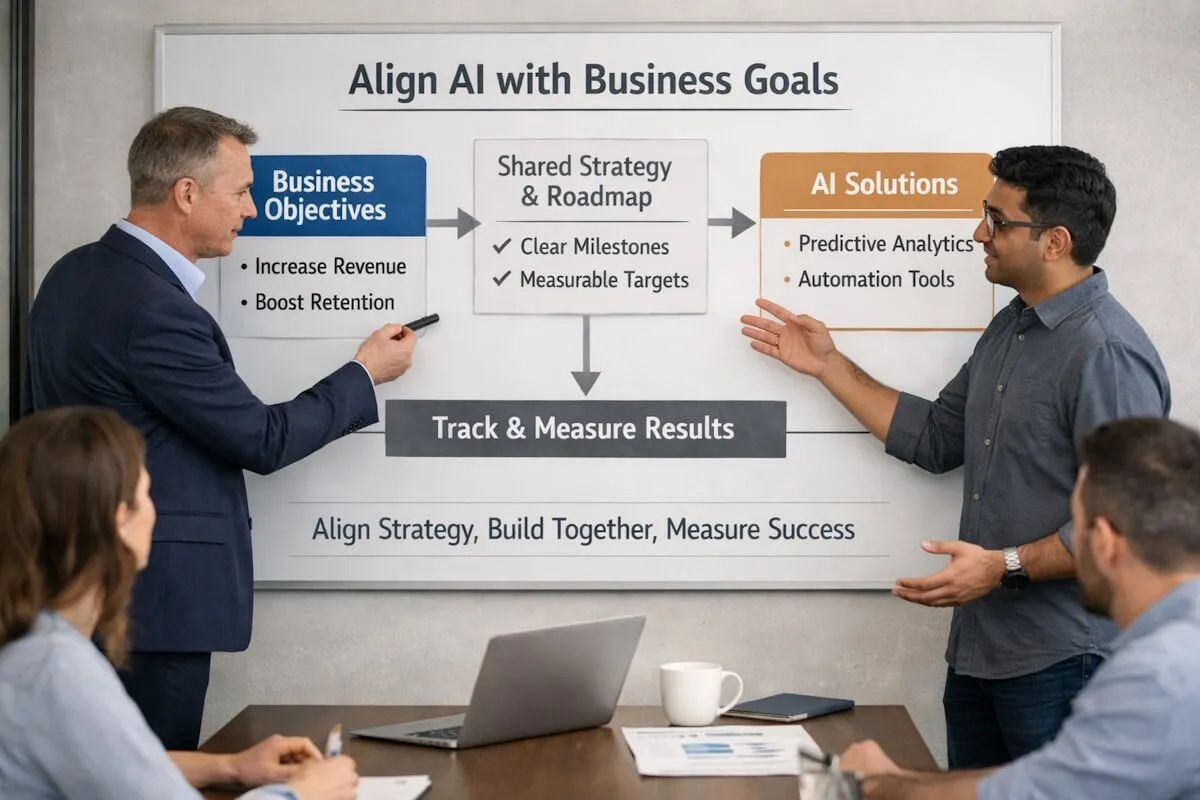
Instead of separate plans, create one shared roadmap that connects business goals with technical execution.
This roadmap should answer:
- What are we building?
- Why are we building it?
- What impact do we expect?
- How will we measure success?
It doesn’t need to be overly detailed. But it needs to be clear enough that both leadership and engineering teams understand the direction.
A good roadmap feels like a story. Each step leads to the next. Each feature has a purpose tied to business outcomes.
Prioritize Use Cases That Actually Matter
Not every idea deserves attention.
You might have dozens of potential use cases. Predictive analytics, automation tools, recommendation engines, chat systems. The list goes on.
But here’s the truth. Most of them won’t move the needle.
Focus on use cases that:
- Directly impact revenue or cost
- Solve clear customer pain points
- Improve critical internal processes
Let’s say your sales team spends hours qualifying leads manually. That’s a strong candidate. It affects time, cost, and conversion.
On the other hand, building something just because competitors are doing it? That rarely ends well.
Create a Feedback Loop Between Teams
Alignment is not a one-time task. It’s ongoing.
You need regular communication between business leaders and technical teams. Not just updates, but actual discussions.
What’s working? What’s not? What needs to change?
Set up simple rhythms:
- Monthly reviews of progress and outcomes
- Quick check-ins during key project phases
- Open channels for feedback from both sides
When teams talk openly, issues surface early. Adjustments happen faster. And the gap between strategy and execution stays small.
Balance Speed With Stability
CEOs often push for speed. CTOs often push for stability. Both are valid.
The challenge is finding balance.
If you move too fast, you risk building fragile systems. If you move too slow, you miss opportunities.
So how do you manage this?
Break projects into smaller phases. Deliver value early, then improve over time.
This approach keeps business leaders engaged while giving technical teams room to build properly.
It also reduces risk. You’re not betting everything on one big release.
Invest in the Right Talent
Technology doesn’t run itself. People make it work.
If your team lacks the right skills, alignment becomes harder. Ideas get stuck. Execution slows down.
This is where bringing in external expertise can help. When you Hire AI Developers, you’re not just adding hands. You’re adding experience that can guide decisions, avoid common mistakes, and speed up delivery.
But hiring alone isn’t enough. Those developers need context. They need to understand your business goals, not just technical requirements.
Make sure they’re part of the bigger conversation.
Avoid Overcomplicating the Stack
It’s easy to get carried away with tools and platforms.
More tools do not mean better results.
In fact, too many tools create confusion. Teams spend more time managing systems than solving problems.
Keep things simple:
- Choose tools that fit your needs
- Avoid unnecessary complexity
- Focus on usability and maintainability
A clean, focused setup helps teams move faster and stay aligned.
Focus on Data That Matters
Data plays a huge role in decision-making. But not all data is useful.
Collecting everything without purpose leads to clutter.
Instead, focus on data that directly supports your goals.
If your goal is improving customer retention, track behavior patterns, feedback, and engagement metrics.
If your goal is reducing costs, track process times, error rates, and resource usage.
Make data meaningful. Make it actionable.
Encourage Cross-Functional Ownership
Alignment improves when ownership is shared.
Instead of isolating projects within one department, involve multiple teams.
For example:
- Product teams define user needs
- Engineering teams build solutions
- Marketing teams provide customer insights
- Operations teams highlight process challenges
When everyone contributes, the final outcome is stronger. It also reduces friction later.
People support what they help create.
Set Realistic Expectations
Not every initiative will succeed. That’s normal.
What matters is how you approach it.
Set clear expectations from the start:
- What success looks like
- What risks are involved
- What timeline is realistic
Avoid overpromising. It creates pressure and leads to rushed decisions.
Instead, focus on steady progress. Small wins build confidence and momentum.
Measure, Learn, Adjust
Once something is launched, the work isn’t over.
You need to track results. Compare them against your goals.
Did you hit your targets? If not, why?
Maybe the solution needs improvement. Maybe the original assumption was off.
That’s fine.
The key is to learn and adjust quickly. Treat each initiative as part of a larger journey.
Build a Culture That Supports Alignment
Tools and processes matter. But culture matters more.
If your company values collaboration, clarity, and accountability, alignment becomes easier.
Encourage:
- Open communication
- Honest feedback
- Shared responsibility
Avoid blame. Focus on solutions.
When people feel safe to speak up, better decisions happen.
Where It All Comes Together
At the end of the day, alignment is about connection.
Connecting vision with execution. Connecting business goals with technical efforts. Connecting people across teams.
It’s not about chasing trends or building the latest features. It’s about solving real problems in a way that supports your company’s direction.
So ask yourself:
- Are your initiatives tied to clear business goals?
- Do your teams understand the “why” behind what they’re building?
- Are you measuring what actually matters?
If the answer is no, that’s where you start.
If the answer is yes, you’re already ahead of many.
Either way, there’s always room to improve.
Let’s Keep It Real
You don’t need perfect alignment. You need consistent alignment.
It’s okay if things get messy sometimes. What matters is how quickly you bring things back on track.
Stay focused. Keep communication open. Make decisions based on real needs, not assumptions.
That’s how CEOs and CTOs move from disconnected efforts to meaningful results.