
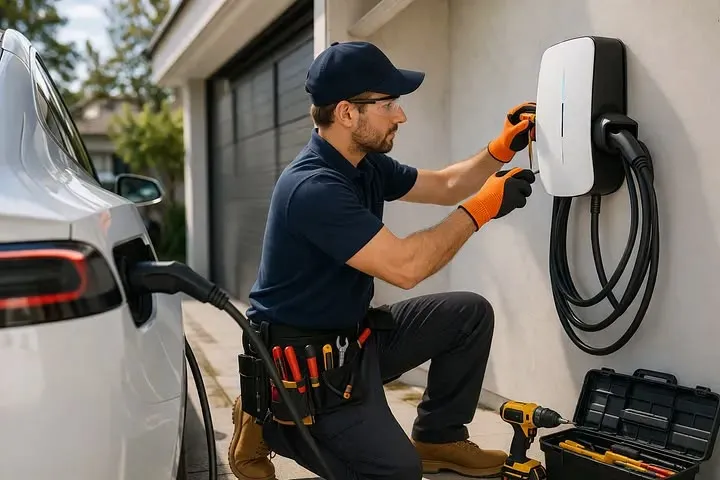
Cold weather changes the way people use their vehicles, driveways, garages, and outdoor equipment. For homeowners preparing a Residential Ev Charging Installation, winter planning should include more than charger power. Snow storage, cable handling, outdoor access, lighting, and the distance between the vehicle and electrical panel can all affect daily use. A charger that works well in mild conditions can become inconvenient when the cable is buried by snow or the usual parking position changes after a storm.
Watch Where Snow Is Usually Piled
Before selecting a mounting location, think about how the driveway is cleared. Snowbanks often build up along walls, fences, or the edges of parking spaces the same areas that may initially look convenient for a charger.
A charger should remain reachable after regular snow clearing. The cable and connector also need a place where they are less likely to be covered, driven over, or struck by a shovel.
Consider the Vehicle’s Winter Parking Position
Some households park differently during winter to make snow removal easier. A vehicle that normally sits close to one wall may be moved toward the center of the driveway or backed into a garage.
The charging cable should comfortably reach the vehicle in the position used most often, not only the ideal summer arrangement.
Plan Cable Storage
A long charging cable can be helpful, but it should not lie across a walkway or remain on wet or icy ground unnecessarily. Think about how the cable will be stored between uses and whether the connector can be kept easy to access.
Good cable management makes the routine simpler in gloves, darkness, or freezing conditions.
Use Adequate Lighting Around the Charging Area
Winter charging often happens before sunrise or after dark. A well-lit charging location makes it easier to see the connector, cable, and surrounding walkway.
Lighting should be planned as part of the parking area rather than added as an afterthought. It can also help with general winter safety when snow and ice reduce visibility.
Coordinate the Cable Route With the Property
An Electrical Installation Service Longueuil may involve routing cable through finished areas, garages, or exterior sections depending on the property. The most direct route is not always the easiest or most practical.
Homeowners should think about future access, whether the garage will be renovated, and where storage or other equipment may eventually be placed. A route that remains accessible can make later maintenance simpler.
Check the Home’s Electrical Capacity First
Winter convenience should not distract from the electrical fundamentals. The charger still needs to be planned around the panel, available capacity, circuit requirements, and the vehicle’s charging capability.
Electric heating can also contribute significantly to household demand during cold periods, making a proper load assessment particularly relevant when a charger is added.
Avoid Choosing Power Based on Maximum Ratings Alone
The fastest available charger is not automatically the best match. Daily driving distance and overnight parking time determine how quickly the vehicle actually needs to recover energy.
A household where the vehicle remains parked for ten or twelve hours may have more flexibility than a driver who returns late and leaves early.
Think About a Second Vehicle
Even if only one EV is owned today, consider whether another may be added. The current installation does not need to include a second charger, but location and panel planning can leave room for future changes.
This is especially helpful when walls or ceilings are already open for other work.
Test the Routine, Not Just the Equipment
After installation, pay attention to how the setup works during real winter conditions. Is the cable easy to reach? Does snow removal interfere with it? Is the area bright enough at night?
Small adjustments to parking or cable storage can improve the experience significantly.
Conclusion
Home EV charging in winter is partly an electrical project and partly a daily-use design problem. Snow, darkness, parking habits, cable storage, and cold-season household demand all influence how practical the setup feels.
By choosing the location with winter routines in mind and coordinating it with panel capacity and cable routing, homeowners can create a charging area that remains convenient throughout the year. The best installation is not simply the most powerful one; it is the one that still works naturally when the driveway, weather, and household routine are at their most demanding.